The 4 M’s of Mental Health: A Neuroscience-Backed Framework for Wellbeing
When people think about mental health, they often search for a single breakthrough—a new insight, a medication, or a mindset shift that changes everything. But research in neuroscience and positive psychology points to something more sustainable: mental health is built through daily practices that reshape the brain and nervous system over time.
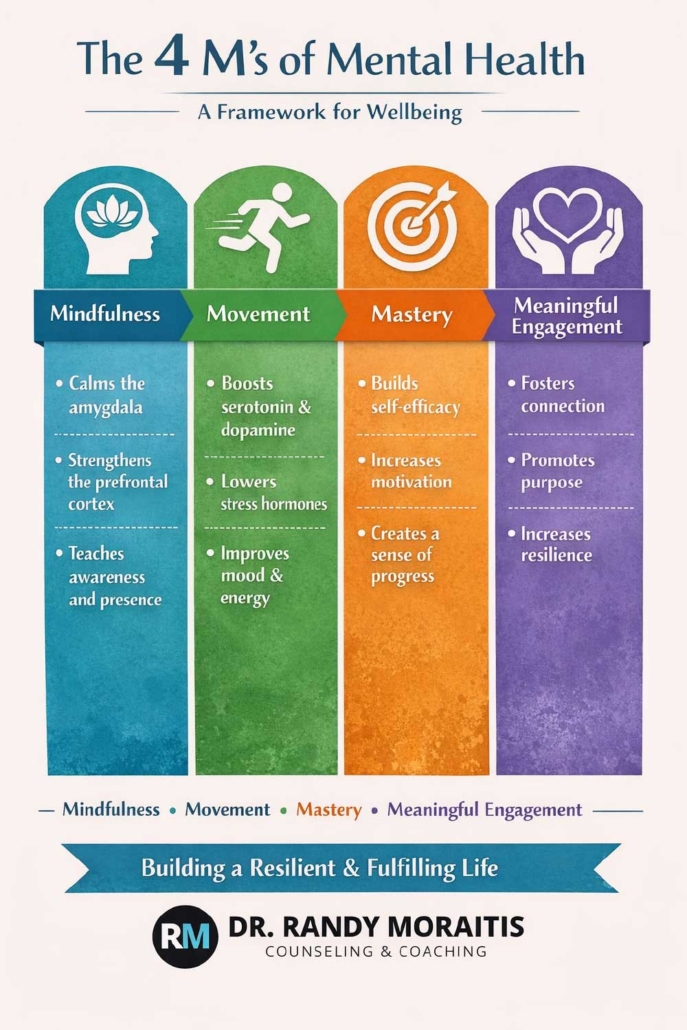
One simple and powerful framework is the 4 M’s of Mental Health:
Mindfulness, Movement, Mastery, and Meaningful Engagement
Each of these pillars supports emotional regulation, resilience, motivation, and long-term psychological wellbeing.
- Mindfulness: Creating Space Between Stimulus and Response
Mindfulness is the foundation of mental health because it teaches the nervous system how to slow down, notice, and regulate.
From a neuroscience perspective, mindfulness practices:
- Decrease activity in the amygdala, the brain’s threat detection center
- Strengthen the prefrontal cortex, which governs emotional regulation, impulse control, and wise decision-making
- Improve connectivity between the thinking and feeling centers of the brain
Rather than reacting automatically to stress, mindfulness allows a person to respond with awareness and choice.
Practices such as slow breathing, prayerful awareness, body scans, and present-moment attention help shift the nervous system out of survival mode and into a state of safety and balance. Over time, mindfulness literally rewires the brain toward greater calm and clarity. Try the free UCLA Mindful app as a great resource for guided mindfulness exercises.
- Movement: Regulating the Mind Through the Body
Mental health is not only a cognitive experience—it is a physiological one. Movement helps regulate the brain by stabilizing the body. I exercise daily, and I encourage all of my clients to do the same.
Research shows that physical activity increases:
- Serotonin, supporting mood stability
- Dopamine, enhancing motivation and focus
- Endorphins, improving emotional resilience
- BDNF (Brain-Derived Neurotrophic Factor), which supports neuroplasticity, learning, and memory
Movement also reduces cortisol (the stress hormone) and improves sleep—two crucial factors for emotional regulation.
Importantly, movement doesn’t need to be intense or extreme. Walking, stretching, strength training, yoga, or gentle daily movement all communicate safety and vitality to the nervous system. Try activities you like; otherwise, you won’t stick with them!
- Mastery: Building Confidence Through Progress
Mastery is the experience of growing competence through effort and practice. It plays a powerful role in both mental health recovery and long-term wellbeing.
Positive psychology research shows that mastery builds:
- Self-efficacy
- Motivation
- Hope
- Psychological resilience
From a neuroscience standpoint, mastery stimulates dopamine in healthy, sustainable ways—through progress rather than instant gratification. This strengthens motivation circuits and reinforces neural pathways associated with confidence and persistence.
Mastery doesn’t require perfection. It can be:
- Learning a new skill
- Practicing emotional regulation
- Maintaining sobriety one day at a time
- Becoming more consistent with healthy habits
Each small success teaches the brain: “I am capable.” Think of yourself as a lifelong learner and keep learning new things!
- Meaningful Engagement: The Healing Power of Purpose and Connection
Humans are wired for meaning and connection. Without it, comfort alone rarely produces fulfillment.
Meaningful engagement includes:
- Deep relationships
- Faith or spiritual practices
- Service to others
- Values-driven work and community involvement
Neuroscience shows that meaningful engagement increases oxytocin levels, which promote trust, emotional bonding, and stress resilience. Positive psychology research consistently demonstrates that a sense of meaning is one of the strongest predictors of psychological wellbeing.
When life feels purposeful, the brain’s reward systems activate in ways that reduce rumination and despair. Meaning gives suffering context and helps people endure hardship with hope. Life is better together!
Bringing the 4 M’s Together
The strength of this framework lies in its integration:
- Mindfulness increases awareness and emotional regulation
- Movement stabilizes mood and the nervous system
- Mastery builds confidence and motivation
- Meaningful engagement provides purpose and connection
You don’t need to excel in all four areas at once. Even modest, consistent steps in each domain can produce meaningful change over time.
Final Thought
Neuroscience calls it neuroplasticity. Psychology calls it growth. Faith calls it renewal.
When mindfulness, movement, mastery, and meaningful engagement become part of daily life, mental health shifts from simply managing symptoms to building a life that is resilient, meaningful, and whole.
Phone: 949-303-8264
Email: randy@randymoraitis.com
Website: www.randymoraitis.com
Facebook: https://www.facebook.com/RandyMoraitisCoach/
Twitter: @rmoraitis
About Dr. Randy Moraitis
Dr. Randy Moraitis is a Positive Neuropsychologist, counselor, coach, and interventionist based in Laguna Niguel, where he lives with his wife, Kim. Together they enjoy their blended family of five adult children and three grandchildren—photos always available upon request!
Randy holds a PhD in Positive Neuropsychology and is a Board-Certified Positive Neuropsychologist, Certified Intervention Professional (CIP), and CADC II. He is highly regarded for his work helping individuals and families navigate addiction, mental health challenges, and personal transformation through counseling, coaching, and professional interventions.
A multi-award-winning Board-Certified Pastoral Counselor and ordained minister, Randy brings a unique, integrated approach to healing and growth. He also holds six professional coaching certifications and specializes in executive, life, wellness, and recovery coaching.
Randy’s educational background includes a master’s degree emphasizing theology and counseling, a bachelor’s degree in management and leadership, and a certificate in health and fitness with an emphasis in exercise physiology and sports psychology from UC Irvine.
For more than 25 years, Randy has guided individuals, families, and organizations toward mental, emotional, physical, and spiritual well-being throughout Orange County. He maintains a private practice office in Laguna Niguel, California, and sees clients and patients both in person and virtually.




 A very basic description of pharmacogenomics is that based on genetics, people have one of four different levels of metabolizing drugs: Poor Metabolizer, Intermediate Metabolizer, Extensive (“Normal”) Metabolizer and Ultra Rapid Metabolizer. One’s level of metabolizing determines which drugs are best for that patient.